Livecadia: latency testen of remote arcade games
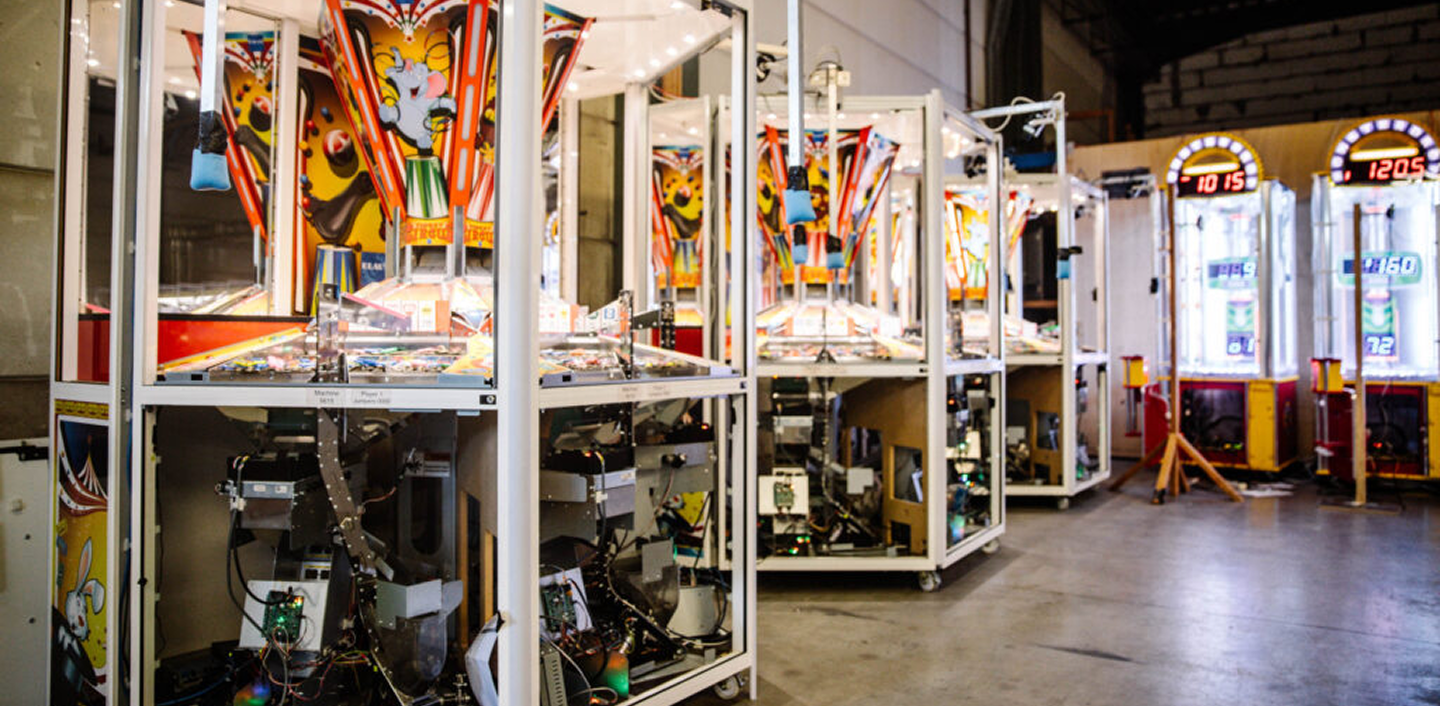
Since 1959, Elaut Group has been active in the amusement games industry. Most of the machines you see at fairs and in arcades were likely designed and produced by them. Elaut is an innovative global player in electro-mechanical games and continuously adopts new technologies to raise the quality of their games.
Because of this innovative mindset, they partnered with Refleqt. Elaut was taking its first major steps in digitalization and wanted a platform to livestream games so that people could play arcade machines from their smartphone—in other words, operate a claw machine from their couch to win a prize.
Customer need
Om dit verhaal waar te maken, kwam al redelijk snel aan het licht dat de latency van de videobeelden een enorme uitdaging was. De latency is de tijd die gegevens nodig hebben om van punt A naar B en terug te gaan. Wanneer je een commando stuurde naar de grijpmachine, duurde het bij de eerste interne testen meer dan vijf seconden vooraleer je op het scherm de grijparm zag bewegen. Dit was veel te traag voor dit type spel.
Daardoor kwam Elaut bij Xplore Group aankloppen. Meer bepaald bij Refleqt, Cloudway, AppFoundry en Gluo. Hun vraag was zo complex dat we de expertises van deze vier competentie centers binnen onze groep moesten bundelen om een Proof-of-Concept (PoC) op te stellen. Vooraleer we uitspraken deden over de haalbaarheid van het project, moesten we dit eerst in het klein testen.
Proof of concept
The project started as a close collaboration between Refleqt and Cloudway, our partner specialized in cloud-native development. After several brainstorming sessions, we defined a five-step plan to test latency.
From a custom-built web application, we sent MQTT messages to a Raspberry Pi – the same type of hardware component used to control real claw machines. Instead of connecting an actual claw machine to the Raspberry Pi, we connected a screen. This screen continuously switched between red and green depending on the message sent via MQTT.
proof of concept
Finally, we continuously recorded the screen with a camera. The video stream signal was also sent to the hardware component, which then relayed it back to the web application. Using image recognition, we detected the exact moment the screen changed color.
This setup was ideal for our proof of concept. We logged the timestamp when we sent the signal to switch the color, and we logged a second timestamp when image recognition confirmed that the color had actually changed. By comparing these two measurements, we were able to calculate end-to-end latency.
Execution proof of concept
Once we had defined the setup, we started executing measurements. We ran hundreds of thousands of tests to determine latency and fully automated this process. To ensure a thorough approach, we tested across different network types: Wi‑Fi, 3G, and 4G.
Because Elaut operates globally, it was important to measure latency on a global scale. We conducted tests from Oregon and Virginia in the US, Ireland, Mumbai in India, and Sydney in Australia. In doing so, we had to take into account that both the Raspberry Pi and the software were running from Belgium, which could introduce additional delays.
Because this process was so fast, we contacted AWS, our leading cloud computing provider, to validate our findings. We wanted to be sure our measurements were accurate. To answer our question, AWS set up a small environment to independently verify the latency results. Their test confirmed that our measurements were correct.
Finally, AppFoundry also built a mobile application that was connected in a similar way to a real physical claw machine. With exactly the same technical setup, we controlled the machine via MQTT commands and had a real-time video stream available inside the app. This allowed us not only to perform a technical validation, but also to experience the latency ourselves in real-life scenarios.
Result
Collaboration across multiple disciplines
Looking back on this proof of concept, one thing is clear: we could not have done it alone. We worked closely with several partners throughout the project:
- Cloudway: responsible for setting up the entire cloud infrastructure, including processing the video stream in the application.
- AppFoundry: developed the front end of the application that lets you control the claw and win a plush toy.
- Gluo: handled DevOps and automation of the cloud infrastructure.
- Elaut: set up and configured the cameras.
Without bringing together these experts from different domains, it would have been practically impossible to deliver this PoC—or the timeline would have been significantly longer. Instead, we were able to set up and execute the PoC in just three weeks.
Latency gave the green light to make Livecadia a reality
The central challenge in this project was reducing latency as much as possible. During the PoC, we encountered several bottlenecks that impacted latency, including the camera itself.
When the cameras were configured to send maximum image quality, they became a limiting factor because of the large amount of data being transmitted. To address this, we fine-tuned several settings, such as lowering the number of frames per second. The final result still delivered very clear images, without any negative impact on performance.
Delivering this PoC was a technical achievement, and we are proud of what we accomplished. The PoC’s sole purpose was to determine whether Elaut’s request was technically feasible.
With this project, we demonstrated that it is indeed technically possible to play arcade games remotely, via a video stream, in near real time. The outcome gave us the green light to move forward with the full implementation of Livecadia. Stay tuned – we will soon share more about the development story behind Livecadia.
Related cases
We help organizations gain control over quality and performance with solutions that match their current maturity as well as their future growth.

Chaos engineering by sportsgiant
During the Innovation Days at a leading sports A-brand, we worked together with Gluo on the company’s first chaos engineering experiments — a real ...

Freight Tracking System
Developing a Freight Tracking System consisting of a live dashboard that enables users to monitor just-in-time logistics processes in real time and ...

Milan Meuleman
Business development & sales
Contact Refleqt today
Would you like more control over software quality, test automation, or performance? We are happy to explore together how we can support your team with an approach that works in practice.